Could a quantum computer crack Bitcoin? First check whether your public key is on-chain
Today's quantum computers can't break Bitcoin. The kind of quantum computer that could work a private key back out of a public key hasn't been built, and the Bitcoin Improvement Proposal BIP-360 itself acknowledges that it's unclear when such a machine might be usable, or whether one can be built at all.
Even if such a machine arrives, it won't hit all bitcoin at once. First in line are the coins whose public keys are already on the chain: early P2PK outputs, addresses that have been reused, and Taproot addresses starting with bc1p. Other common address types only fall into that group once a script reveals the public key, which usually happens when the coins are spent. For an ordinary holder, the main thing you can do right now is stop reusing receiving addresses.
The ECDSA and Schnorr signatures Bitcoin uses are what Shor's algorithm threatens
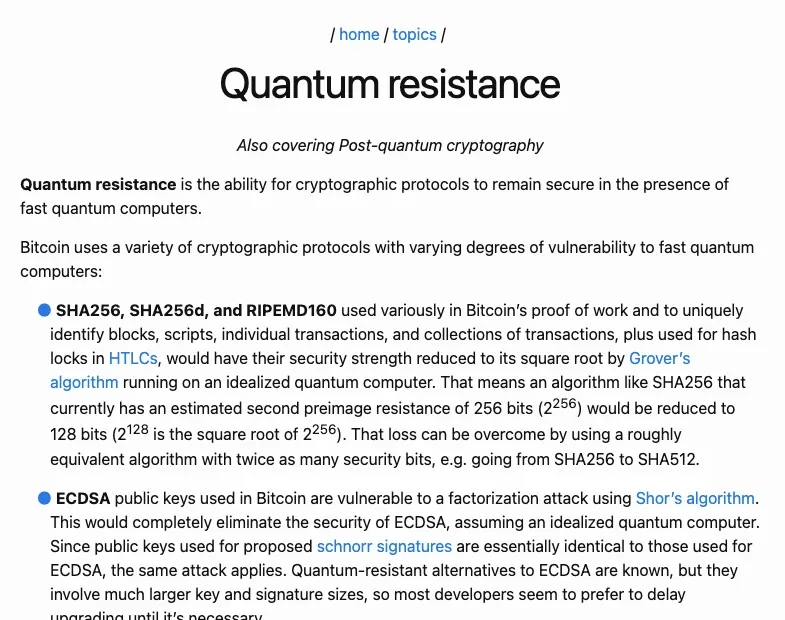
The cryptography in Bitcoin that quantum computing could hit falls into two groups, and they are affected to very different degrees. Bitcoin Optech, a site that publishes technical news for Bitcoin developers, lists the two separately on its Quantum resistance topic page:
| Component | What it does in Bitcoin | Quantum algorithm | Result on an idealized quantum computer |
|---|---|---|---|
| ECDSA signatures, Schnorr signatures | Prove you have the right to spend the coins | Shor's algorithm | The security of ECDSA is completely eliminated; Schnorr uses essentially the same public keys as ECDSA, so the same attack applies |
| SHA256, SHA256d, RIPEMD160 | Proof of work; identifying blocks, scripts and transactions; hash locks in HTLCs | Grover's algorithm | Security strength drops to its square root, for example from 256 bits to 128; switching to an algorithm with twice the bits (such as SHA512) makes up the loss |
Signatures are where the real danger lies. BIP-360 names them as the main threat quantum computers pose to Bitcoin: Shor's algorithm solves the discrete logarithm problem exponentially faster than classical methods, so it can derive a private key from a public key, a process the proposal calls quantum key recovery. Whoever has the private key can sign the coins away.
Attack capability probably won't jump from nothing to full strength overnight. As quantum computers grow in size and reliability, it is more likely to pass through stages in turn: computationally infeasible, theoretically possible but impractical, extremely expensive, very expensive, and finally practical. As long as progress follows that order and can be tracked in public, Bitcoin can probably keep its current, very compact cryptography and switch to post-quantum cryptography when the need gets close. Quantum-resistant signature schemes already exist, but their keys and signatures are much larger, which seems to be why most developers prefer to hold off on switching.
Which Bitcoin addresses already have their public keys on-chain
Quantum attacks are split into two kinds by how long the public key has been exposed:
- Long exposure attacks: these target data that is already public on the chain, such as exposed public keys and the scripts of spent outputs. As long as the coins stay in that output, an attacker has unlimited time to recover the private key, which makes this probably the first quantum attack that becomes feasible.
- Short exposure attacks: these have to be completed in the short window while a transaction is unconfirmed and waiting in the mempool, which needs a faster quantum computer. Most Bitcoin transactions have to reveal the public key when they spend, so wallet habits can't defend against this kind; full protection may depend on post-quantum signatures.
Long exposure is the part an ordinary holder can control. Here is how each output type stands; you can match them by how the address starts:
| Output type | Address starts with | Vulnerable to long exposure attacks? |
|---|---|---|
| P2PK | No fixed prefix | Yes |
| P2MS (bare multisig) | No fixed prefix | Yes |
| P2PKH | 1 | No* |
| P2SH | 3 | No* |
| P2WPKH, P2WSH | bc1q | No* |
| P2TR (Taproot) | bc1p | Yes |
The types marked * can become vulnerable at any time once their script reveals a public key. Three kinds are listed as fundamentally vulnerable: P2PK outputs (the examples given are Satoshi's coins and coins from early CPU mining), reused outputs, and Taproot outputs starting with bc1p.
Check it against the most common case. If your bc1q address has only ever received coins and never sent any, its public key isn't on the chain yet. If the same address has received several times and spent once in between, the public key behind the coins left at that address is already public. That is the long exposure that address reuse creates.
BIP-360 and BIP-361, the two quantum-resistance proposals, are both still drafts
Bitcoin's response at the protocol level is still at the proposal stage, and neither of the two in the table has been activated:
| Proposal | Title | Status and type | Number assigned |
|---|---|---|---|
| BIP-360 | Pay-to-Merkle-Root (P2MR) | Draft; Specification; consensus-layer soft fork | 2024-12-18 |
| BIP-361 | Post Quantum Migration and Legacy Signature Sunset | Draft; Informational; consensus-layer soft fork | 2026-02-11 |
BIP-360 would use a soft fork to add a new output type, P2MR, with addresses starting with bc1z. It works almost exactly like Taproot, except that the key path spend, which exposes the public key, is removed. That only protects against long exposure attacks; defending against short exposure attacks may also require post-quantum signatures in Bitcoin, which the authors intend to put forward in a separate proposal. The proposal has been renamed twice: it started as P2QRH, became P2TSH in September 2025 and only took its current name, P2MR, in February 2026, so older material that mentions P2QRH is describing an early version of it.
BIP-361 envisions publishing a timetable in advance for phasing out the old signatures once some post-quantum output type is in place: Phase A would stop coins from being sent to quantum-vulnerable addresses, and Phase B would tighten how ECDSA and Schnorr spends are validated. Like BIP-360 it is a draft, and its timetable only starts counting from the day it is activated.
Outside Bitcoin, general post-quantum standards already exist. On 13 August 2024, NIST released three: FIPS 203 (ML-KEM, for general encryption), FIPS 204 (ML-DSA, the primary standard for digital signatures) and FIPS 205 (SLH-DSA, also for signatures, as a backup in case ML-DSA runs into problems). Whether Bitcoin adopts one of them, and how, is still being discussed among developers.
What an ordinary holder can do now: use a new address every time you receive
Protection against long exposure attacks doesn't depend on post-quantum signatures being enabled, as long as you don't expose your public keys by reusing them or through other unsafe practices; reusing addresses increases this risk. In practice:
- Receive every payment at a new address generated by your wallet, rather than leaving one address on your profile page or a group announcement to collect payments over and over.
- If your coins are held at an address starting with bc1p, it's enough to know that it belongs in the long-exposure group. That risk only becomes real once a practical quantum computer exists.
Extended public keys (xpubs) and wallet descriptors also reveal quantum-vulnerable public key information, so don't hand them out casually or post them anywhere public.
Address reuse is about on-chain addresses. How an exchange account differs from a wallet where you hold the private keys yourself is covered in our guide to exchange wallets versus on-chain wallets. To check an address's format before a transfer, you can use this site's address format checker. It only tells you whether the format is valid; whether the receiving address is the one you mean to pay, you still have to check character by character yourself.
Quantum attacks hit Bitcoin's signatures far harder than its mining hashes
Could a quantum computer steal Satoshi's bitcoin?
P2PK outputs write the public key directly on the chain and are fundamentally vulnerable to long exposure attacks; Satoshi's coins and coins from early CPU mining are examples of this kind of output. For them to actually be moved, someone would first have to build a quantum computer that can run Shor's algorithm.
Would quantum computers make Bitcoin mining stop working?
Proof of work uses hashes like SHA256, which belong in the Grover's algorithm group: their security strength takes a hit, and switching to an algorithm with twice the bits makes up for it. Signatures, by contrast, are broken completely by Shor's algorithm.
Are coins received at a bc1q address exposed to quantum attacks?
bc1q addresses correspond to P2WPKH and P2WSH, which normally aren't vulnerable to long exposure attacks but can become vulnerable at any time once a script reveals the public key. If an address has only received and never spent, its public key isn't on the chain yet; if the same address has received and then spent, the coins left in it fall into the exposed group.